MotoSPEC CHASSIS PROGRAM
  • HOME
  • PRICING & FEATURES
  • DATA AQ
  • CONTACT
  • PURCHASE
  • FAQ
  • TESTIMONIALS
  • MEASUREMENT
  • VIDEOS
  • SUPPORT
  • KNOWLEDGE BASE
  • Ask A SBK Genius

TOP-OUT SPRINGS

1/8/2024

 
To understand the effect of a top-out spring, it can be best to start by examining the forces in the shock or fork, and looking at the force curve of the suspension. 

The suspension rate can then be understood as the slope of the force curve. 

​A current R1 is used as an example.

Where the top-out is engaged, the top-out opposes (subtracts) force from the main spring curve, resulting in a steeper slope.

Rate is just the slope of the force curve (force per mm of travel) so ​the rate is higher where the top-out is engaged.

The rate where the top-out is engaged is the total of the main and top-out rates. 

It is commonly thought that the rate in the top-out zone should be softer, but it is the opposite.  The force is reduced, but the rate is increased.

Where the top-out disengages, the rate drops down to that created only by the main spring.

A shock with 100 N/mm spring and 10 mm preload would require 1000 N (100 N/mm x 10 mm) to overcome the preload force and start to compress the shock.  Adding to the spring force is also the force created by the reservoir pressure.  With a 14 mm shaft and 5 bar reservoir pressure, the reservoir pressure creates 77 N of extension force.

So there is a total of 1077 N of force forcing the shock to full extension.  This is just the shock on its own, as if the shock is sitting on a bench. 

More than 1077 N would have to be applied to start to compress the shock.

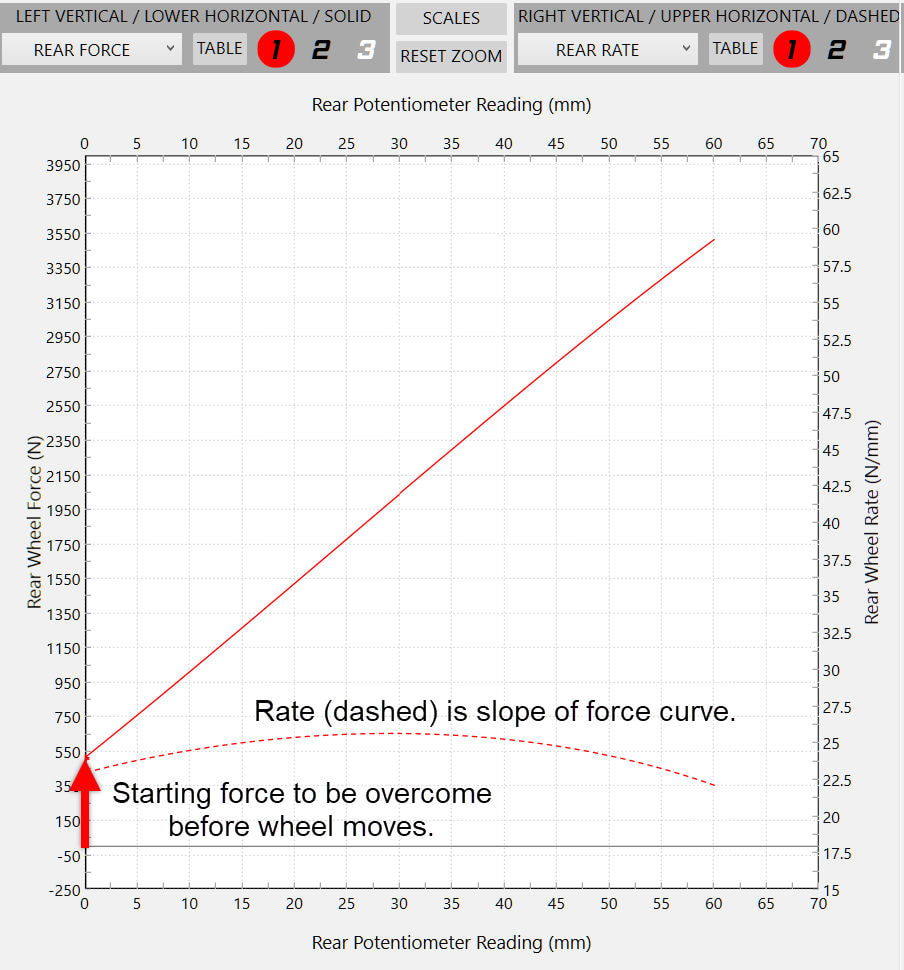
Installed in the bike, the leverage of the linkage and swingarm result in a lower force at the wheel.  With a motion ratio of 0.475:1 (588 swingarm length and 314.5 shock), the force at the wheel is 511 N, a little less than half of the force at the shock.

Looking at the graph below, the solid line is the Rear Wheel Force, plotted against the left vertical axis.  The Rear Wheel Rate is the dashed line, plotted against the right vertical axis.

Picture

This means that a vertical load of 511 N of load would have to be applied to the wheel before the suspension would start to compress.

This is a consequence of motorcycles requiring soft spring rates to provide a soft suspension when leaned over.  A large amount of spring compression is required on the soft spring to support the motorcycle and rider.  This compression is more than that available within the length and stroke of the shock, and so the spring is preloaded.

To avoid preload, the shock would require 10 mm more stroke and be 20 mm longer.  This creates packaging problems in the motorcycle (more link rotation, shock and linkage clearance in the swingarm tunnel and to the exhaust, etc) and also requires more droop travel in the rear suspension.  A shorter shock is used with preload on the spring.

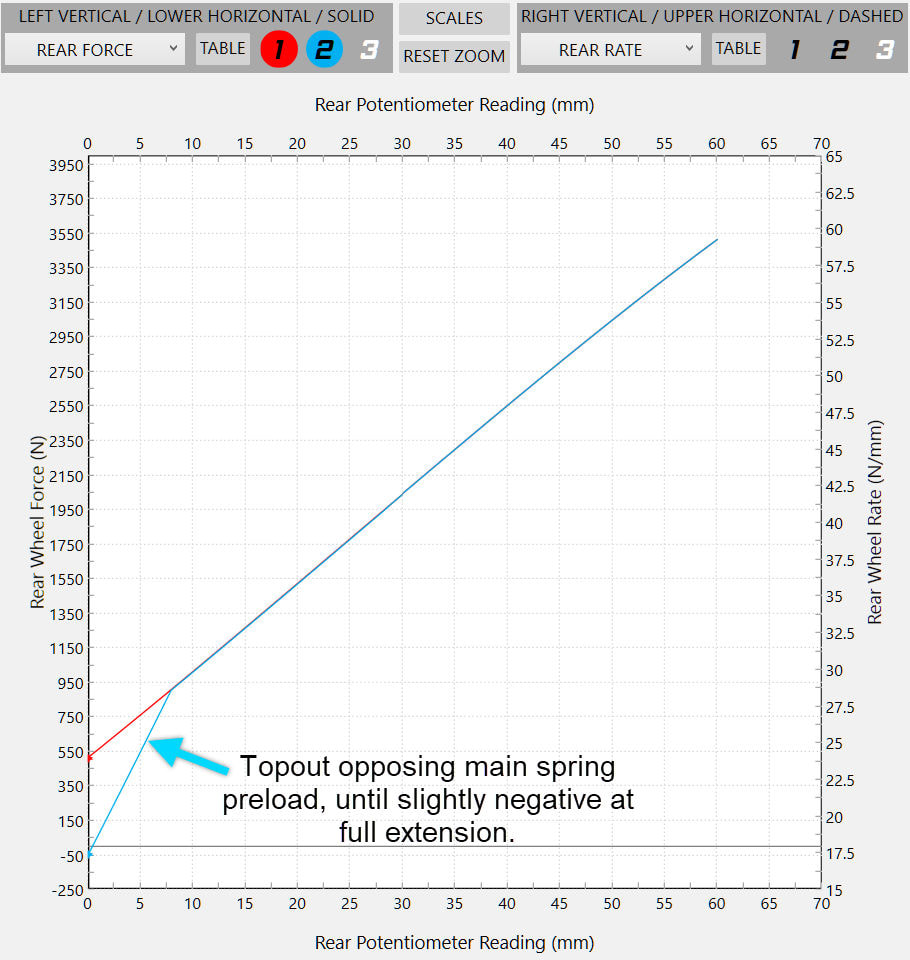
To reduce the amount of force required to start compressing the shock, an  opposing force can be provided by the top-out spring.  To completely offset the extension force would require a top-out spring with capable of 1077 N.

Top-out springs are only available in fixed combinations of rate and length (188 N/mm  by 8 mm long, 150 N/mm x 8 mm, etc).  Exactly matching the top-out spring with the extension force is usually not possible and would require changing the top-out spring whenever a change of main spring and preload is made.  The closest match in this case would be 150x8 to provide 1200 N.

The top-out spring will be contacted at 8 mm from full extension.  Looking at the graph below, with the shock compressed and extending (starting from the right and moving left on the graph), at 8 mm from full extension the top-out will be contacted and start to oppose the main spring force.  

The shock will extend until the extension and top-out spring forces balance, where the force crosses zero of the left axis.  Installed on the bike, the unsprung mass of the rear suspension will also act to extend the shock.

Picture
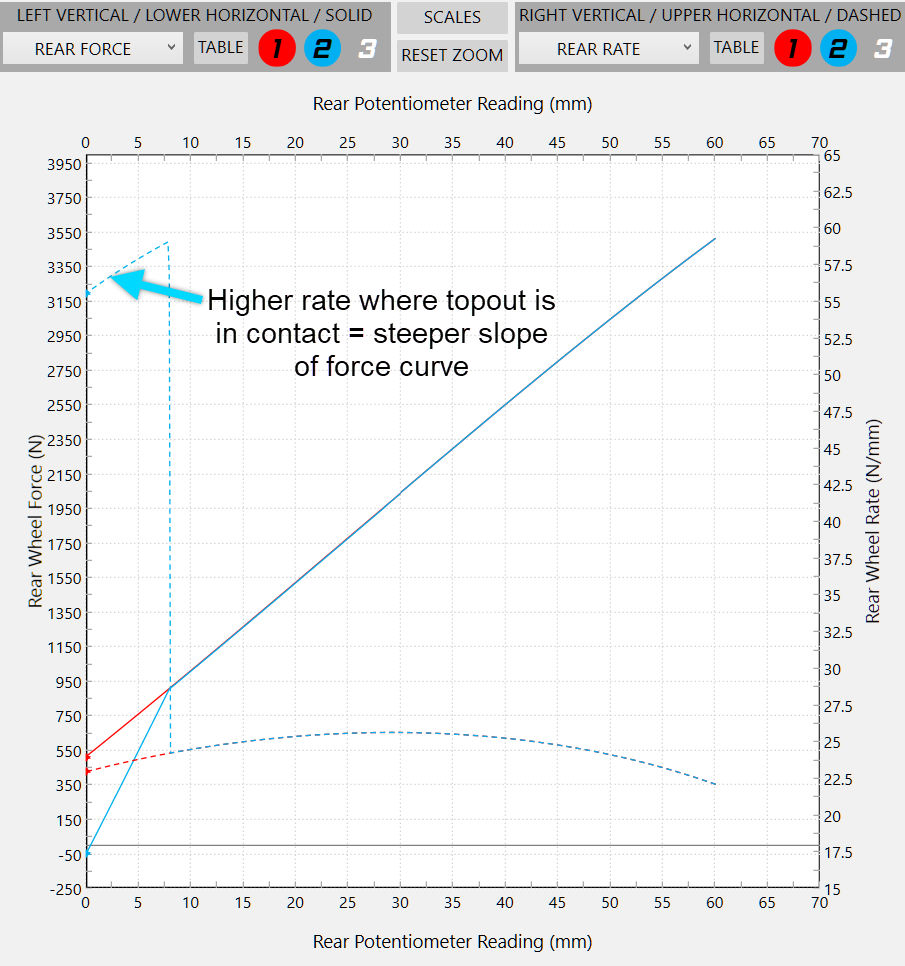
Where the top-out is engaged, the top-out opposes (subtracts) force from the main spring curve, resulting in a steeper slope.

Rate is just the slope of the force curve (force per mm of travel) so ​the rate is higher where the top-out is engaged.

The rate where the top-out is engaged is the total of the main and top-out rates. 

It is commonly thought that the rate in the top-out zone should be softer, but it is the opposite.  The force is reduced, but the rate is increased.

Where the top-out disengages, the rate drops down to that created only by the main spring.

The graph below shows the R1 rear suspension, with and without the top-out spring.
Picture

At the front, fully engaged top-outs can be used to create stiff wheel rates while allowing some ability to add or remove preload.

For example, if 11 N/mm main springs only required a small amount of preload - for example, 1 mm, there is not much scope for preload changes.

And the small amount of preload does not require a typical top-out installed to minimize the force needed to get the wheel moving. 

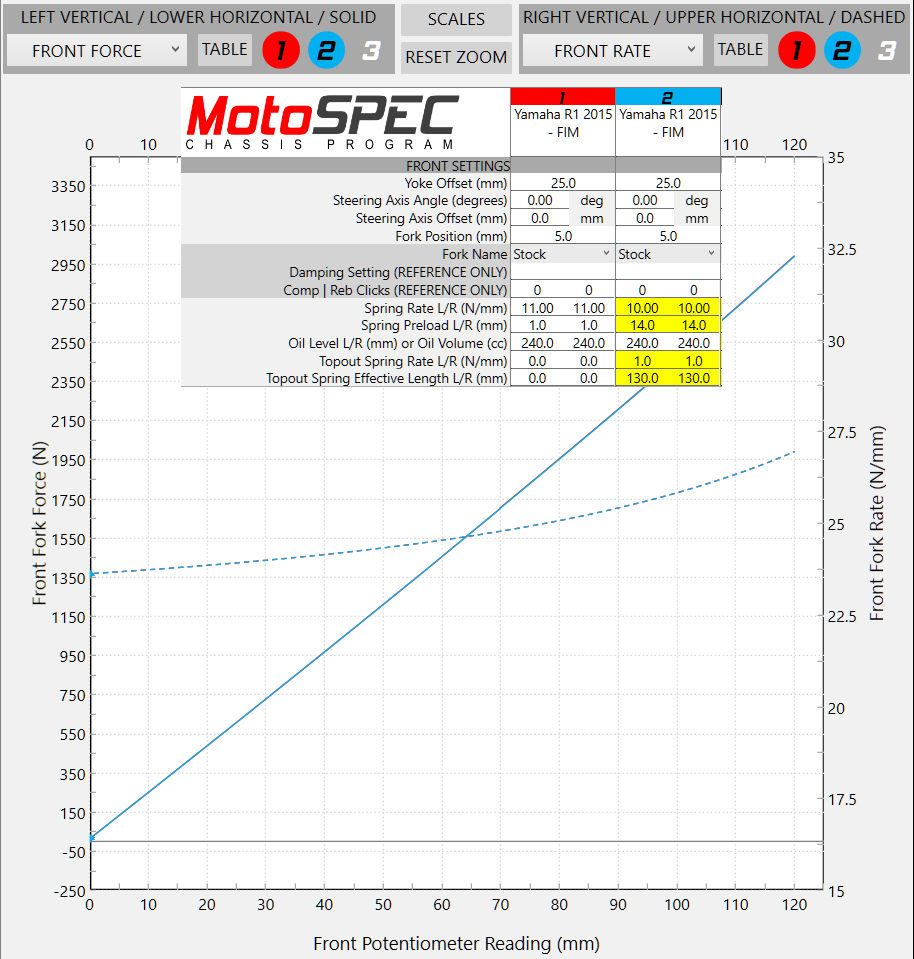
By making the top-out 'fully engaged', the top-outs are engaged over the full stroke of the fork and there is no step in force or rate curves.

As before, the main and top-out rates add.  So 11 N/mm springs are equivalent to 10 N/mm main springs with 1.0 N/mm top-out springs. 

Using 10 N/mm main springs with 14 mm preload with 1.0 N/mm x 130 mm long top-outs generates the same 11 N/mm effective spring rate, but does provide some room for preload changes.

The force and rate curves are exactly the same, so blue and red overlap in the graph below. 

Picture

Comments are closed.

    Blog

    CATAGORIES

    All
    Anti-squat
    Data Aq
    Gearing Table
    HED Files
    Lean Angle
    Rake Adjustment
    SETUP SHEET
    Steering Head Inserts
    Swingarm Length
    Tires

Picture
Copyright @ 2025 MotoRaceServices
  • HOME
  • PRICING & FEATURES
  • DATA AQ
  • CONTACT
  • PURCHASE
  • FAQ
  • TESTIMONIALS
  • MEASUREMENT
  • VIDEOS
  • SUPPORT
  • KNOWLEDGE BASE
  • Ask A SBK Genius